
There are two ways to invest in Africa. The brochure method: big numbers, big optimism, little underwriting. The bank method: assume discontinuity, structure for survival, price reality early.
Step 1: The Country Screen
Before falling in love with the project, score the country across five pillars:
Enforcement and rule system: Contract enforceability, dispute resolution realism, administrative predictability.
Foreign exchange and repatriation: Convertibility, transfer rules, payment discipline. If this is weak, structure offshore cash flows or walk.
Fiscal realism and sovereign interface: Debt stress, arrears culture, tax surprise risk, regulatory volatility.
Security and shock absorption: Stability, policy continuity, probability of abrupt disruption.
Project-to-state fit: Whether the project aligns with national priorities and can survive political cycles.
Step 2: The Structuring Toolkit
Where amateurs tap out, professionals earn their fees:
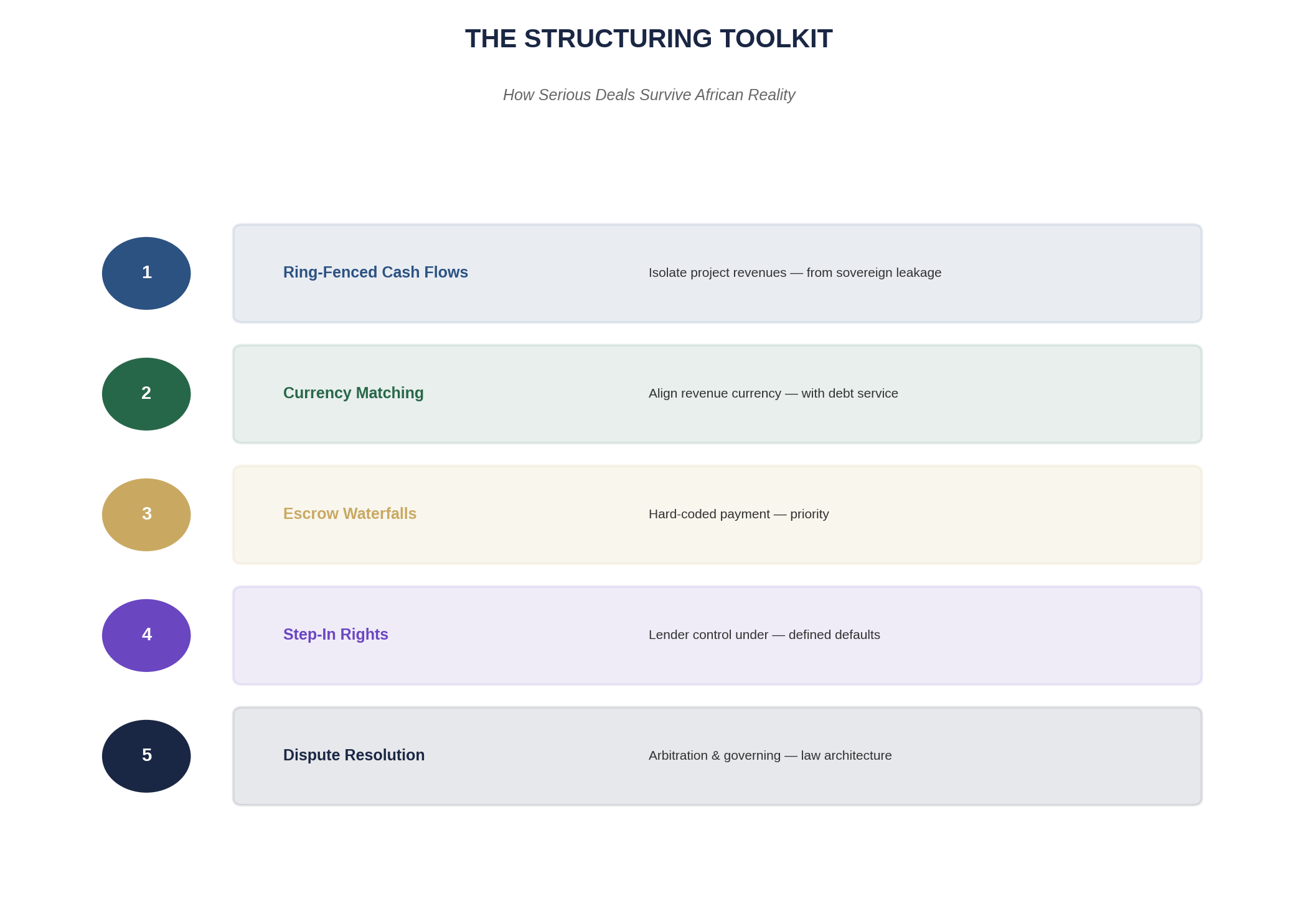
The five essential structuring tools for African deal survival.
- Ring-fenced cash flows: Accounts and waterfalls that reduce leakage
- Currency matching: Or explicit hedging and mitigation where matching is impossible
- Escrow waterfalls: Hard-coded payment priority that survives sovereign stress
- Step-in rights: Clear defaults, cure periods, and lender control mechanisms
- Dispute resolution architecture: Arbitration, governing law, and enforcement pathways
Step 3: The Diligence That Matters
Most diligence fails by focusing on what's easy to document rather than what kills deals.
The real diligence is:
- Enforceability and title clarity
- Regulatory durability
- Tax and transfer pricing risk
- Foreign exchange exposure
- Sovereign payment discipline where the state touches the cash flow
Mandate Scoring Framework

Score each country and deal on 0–5 for each pillar, then apply the decision rule.
Score each country and each deal on 0–5 for each pillar. The decision rule:
| Score | Action |
|---|---|
| 20–25 | Investable; proceed normally |
| 15–19 | Proceed only with heavy structuring and priced protections |
| 10–14 | Proceed only if offshore revenue, strong covenants, and credible counterparties |
| <10 | Decline, unless it is a rescue or distressed mandate explicitly priced as such |
Africa does not lack projects. It lacks structures that survive stress.
The winners—states and investors alike—will be those who treat enforceability and credibility as infrastructure, not as talking points.
Africa's opportunity is real. But opportunity is not a substitute for capacity. The countries that win will be those that make competence boring—and enforcement profitable.
This is Part 10 of a 10-part series on African investment, state capacity, and capital allocation.
Previous: ← Part 9: What African Elites Get Wrong