
African elites are not short of intelligence. They are short of aligned incentives.
Too many systems reward short-term political survival over long-term capability; prestige projects over maintenance; and discretion over rules.
Capital responds rationally: it prices the country as a volatility asset, not a compounding asset.
The Three Recurring Errors
Error 1: Confusing Power with Capacity
Power can command. Capacity can deliver. A state that cannot deliver is ultimately weaker, not stronger.
Error 2: Politicising the Currency
When exchange rates become political trophies, the eventual adjustment becomes violent. Nigeria's multiple exchange rate system, Ethiopia's overvaluation prior to crisis, and Ghana's pre-default currency management all illustrate the pattern.
Error 3: Believing Deals Replace Systems
A mega-project cannot substitute for predictable enforcement. Without institutional machinery, every project becomes an exception—and exceptions do not scale.
The LAPSSET corridor was meant to transform East Africa. But a $25–30 billion vision cannot survive when the state cannot protect contractors from security threats, coordinate across three countries, or mobilise more than 20 per cent of required financing over fourteen years. The deal was announced. The system to execute it was not built.
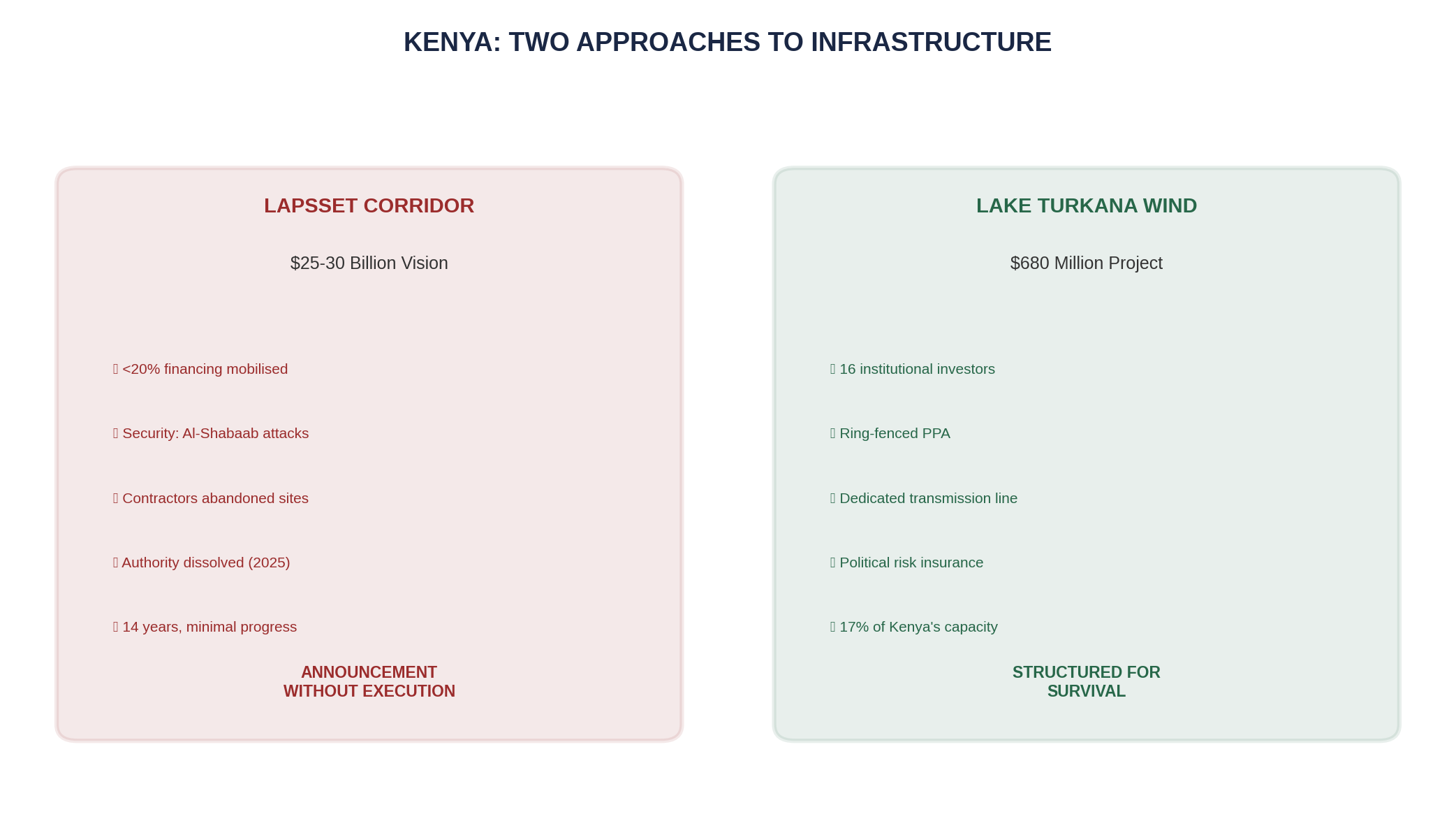
LAPSSET: the deal was announced, but the system to execute it was not built.
The Elite Compact That Changes Everything
Countries shift when elites decide—explicitly or implicitly—that:
- Enforcement pays
- Predictability lowers borrowing costs
- Competence is politically survivable
That compact is the true reform.
Morocco, Mauritius, and Rwanda have, in different ways, reached versions of this compact. Their elites concluded that credibility is an asset class—that the returns from predictable governance exceed the returns from discretionary allocation.
Nigeria, South Africa, and Ethiopia have not yet reached this compact. Their systems still reward disorder more than order. Until that changes, capital will remain short-term, expensive, and extractive.
This is Part 9 of a 10-part series on African investment, state capacity, and capital allocation.
Previous: ← Part 8: Manufacturing vs Consumption