
State capacity is not ideology. It is not regime type. It is not democracy versus authoritarianism. It is whether the state can repeatedly deliver the fundamentals of order: credible policy, predictable enforcement, and basic administrative competence.
A useful public proxy is governance functionality—what the World Bank captures through its Worldwide Governance Indicators: government effectiveness, regulatory quality, rule of law, corruption control, political stability, and voice and accountability. These metrics are imperfect and perception-based, but they are directionally honest. Countries that score well tend to execute. Countries that score poorly tend to announce.
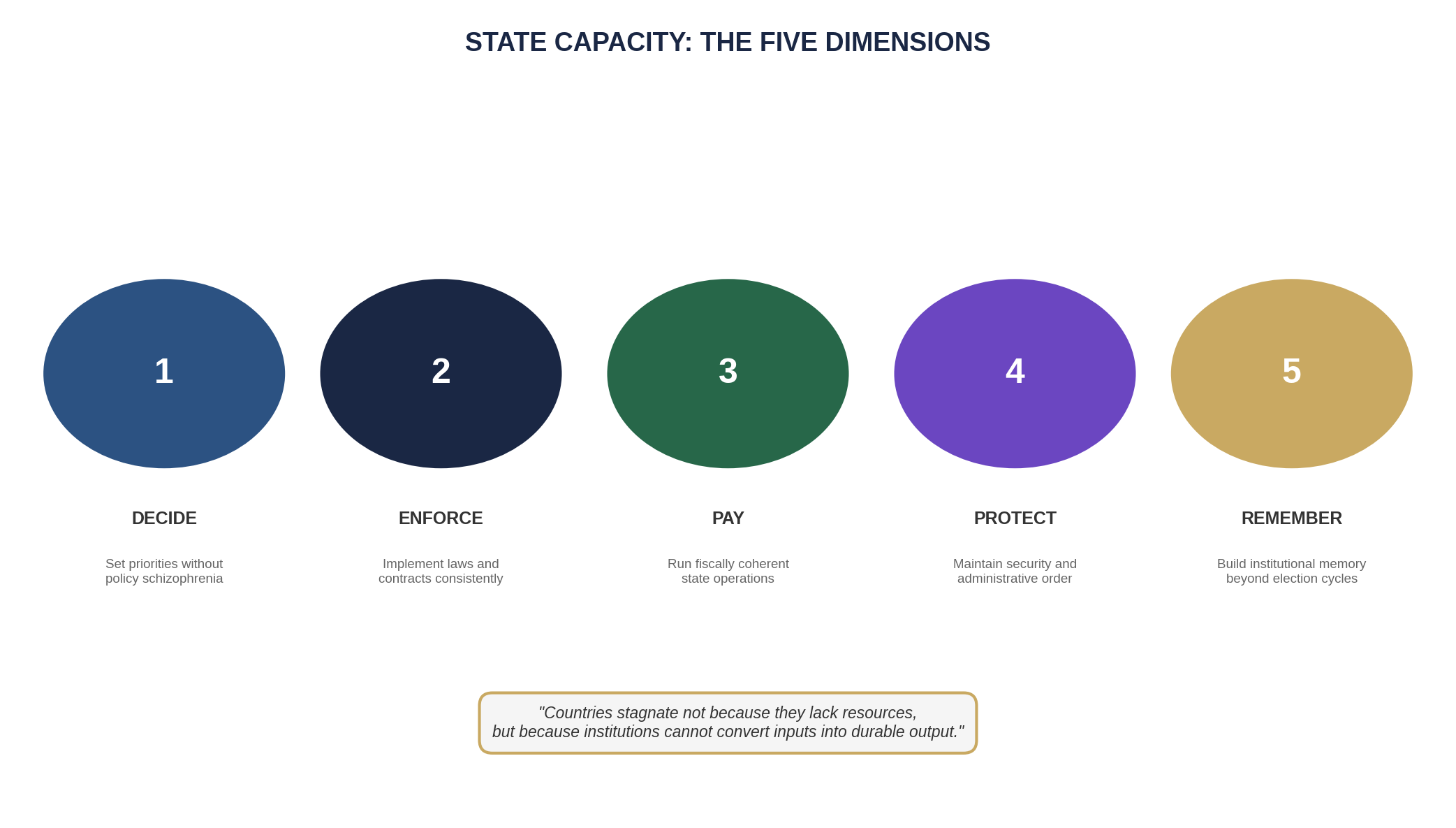
The five dimensions of state capacity: Decide, Enforce, Pay, Protect, Remember.
The Conversion Problem: Nigeria's $25 Billion Refinery Lesson
Africa's largest crude oil producer, home to 220 million people, with proven reserves of 37 billion barrels, has for decades imported refined petroleum products. This is not a resource curse. It is a state capacity failure.
Nigeria's Port Harcourt, Warri, and Kaduna refineries were designed to process 445,000 barrels per day. They have operated at near-zero capacity for years. Between 2010 and 2025, successive governments reportedly spent $18–25 billion on "turnaround maintenance" that produced no sustained output. In 2025, the CEO of the Nigerian National Petroleum Company Limited acknowledged that "sale is not out of the question" for these facilities.
The private sector response was Aliko Dangote's $20 billion refinery in Lagos, the largest single-train refinery in the world at 650,000 barrels per day capacity. It began commercial operations in January 2024 after years of delay. By late 2025, it had experienced catalyst leaks, unit shutdowns, and disputes with international oil traders. The refinery is real and will likely succeed over time—but it exists because a private actor built conversion machinery the state could not.
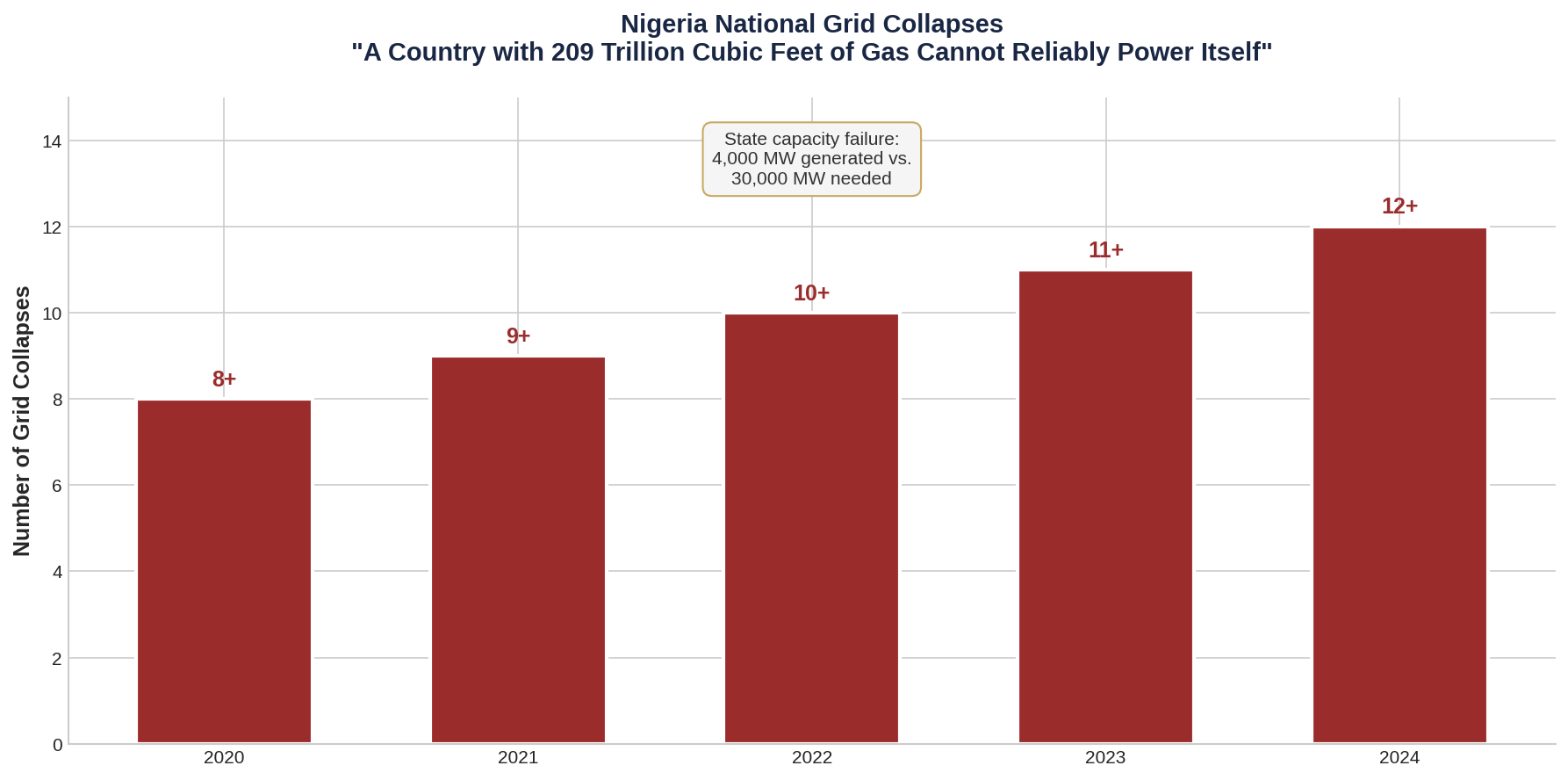
Nigeria's national grid collapsed more than 12 times in 2024—a country with 209 trillion cubic feet of gas reserves.
Meanwhile, Nigeria's national grid collapsed more than twelve times in 2024. The power sector generates roughly 4,000 megawatts for a country that needs 30,000. Pipeline vandalism in the Niger Delta disrupted gas supply to thermal plants throughout the year. Businesses generate most of their own electricity using diesel—the most expensive option, funded by the same dollars that should be capitalising growth.
Nigeria does not lack private dynamism. It lacks state functionality. And for institutional capital, functionality wins—not because it is morally superior, but because it is predictable.
Scale Magnifies Weakness
Large populations magnify the cost of subsidy mispricing, patronage expansion, and administrative leakage. This is why South Africa's inherited institutions are decaying rather than compounding.
South Africa's Eskom, once Africa's most reliable utility, implemented 335 days of load-shedding in 2023, cutting 16.6 million megawatt-hours from the grid. The economic cost was estimated at 6 per cent of GDP. While 2024 saw improvement—only 69 days of load-shedding, with 199 consecutive days without interruption by late 2025—the system remains fragile and dependent on private solar installations that surged from 1.2 gigawatts in 2021 to 6.1 gigawatts by 2024.
Transnet, the state logistics company, cost the economy an estimated 6 per cent of GDP in 2023 through port and rail inefficiency. Mining companies like Anglo American and Sibanye-Stillwater were forced to stockpile exports or use expensive road transport. By 2024, Transnet warned it could not service its 130 billion rand ($7.2 billion) debt without government support.
These are not isolated failures. They are symptoms of institutional decay: competent personnel replaced by politically connected ones, maintenance deferred for decades, and accountability systems that reward loyalty over performance.
Capacity Is Political
State capacity improves when elites benefit more from enforcement than from chaos—when order becomes the path to wealth, not a threat to it. Skills matter. Incentives matter more.
Rwanda illustrates this. By conventional metrics, Rwanda is a small, landlocked, resource-poor country. By capacity metrics, it is among Africa's highest performers. The government's National Strategy for Transformation has delivered measurable infrastructure: an urban development project completed in February 2024 across six secondary cities, a transport portfolio exceeding $665 million by end-2024, and a planned 47 kilometres of dedicated bus lanes in Kigali.
More importantly, Rwanda treats credibility as an asset class. It launched an Open Contracting Data Portal in 2024, making government procurement records publicly accessible since 2016. Investors can trace what was promised, what was contracted, and what was delivered. This is not transparency for its own sake—it is credibility infrastructure that lowers the cost of capital.
Growth without capacity is noise. Capital without credibility is speculation.
This is Part 2 of a 10-part series on African investment, state capacity, and capital allocation.
Previous: ← Part 1: Africa's Rankings Lie